

The silent deficiency
Vitamin D deficiency is called the silent epidemic for a reason: it develops slowly, the symptoms are nonspecific, and blood tests are rarely ordered until a problem is already significant.
The World Health Organization estimates that 1 billion people worldwide have insufficient vitamin D. In the United States, studies suggest 41% of adults are deficient — below 20 ng/mL — and over 70% fall below the 40 ng/mL level many researchers consider optimal.
This matters because vitamin D is not just a bone mineral. It is a steroid hormone that regulates hundreds of genes, modulates immune function, controls inflammatory pathways, and supports neurological and cardiovascular health.
Take the free supplement quiz →
---
Who is most at risk?
- Geographic location — UVB radiation, the wavelength that triggers vitamin D synthesis in skin, is only strong enough between roughly 35°N and 35°S latitude. If you live north of Los Angeles or Atlanta, you cannot synthesize adequate vitamin D from sunlight for 4–6 months of the year.
- Indoor lifestyle — office workers, students, and homebound individuals often go weeks without meaningful sun exposure. Even people in sunny climates can be deficient if they work indoors.
- Darker skin tones — melanin acts as a natural sunscreen. People with darker skin need 3–5x more sun exposure to synthesize the same amount of vitamin D, and studies consistently show higher deficiency rates in Black and South Asian populations, even in sunny climates.
- Age — skin efficiency at synthesizing vitamin D declines by ~75% between age 20 and 70, putting elderly adults at high risk regardless of sun exposure.
- Obesity — vitamin D is fat-soluble and gets sequestered in adipose tissue, so people with obesity need substantially higher doses to reach the same serum levels.
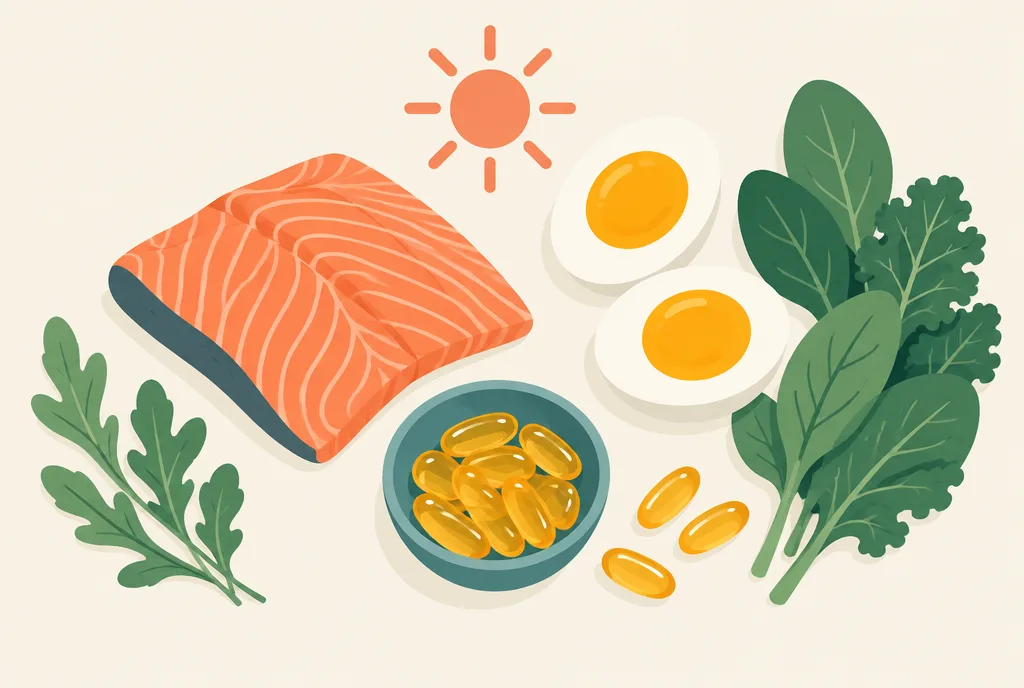
- Malabsorption and diet — celiac disease, Crohn's disease, and bariatric surgery all impair absorption, and vitamin D occurs naturally in very few foods — mainly fatty fish, egg yolks, and organ meats — so vegans get negligible dietary vitamin D.
Signs and symptoms
Deficiency rarely presents dramatically — the symptoms are vague, overlapping, and easy to blame on stress or aging.
- Fatigue and low energy — one of the most consistent and underrecognized symptoms
- Bone pain or achiness — particularly in the back, hips, and legs
- Muscle weakness — difficulty climbing stairs or rising from chairs
- Frequent infections — respiratory infections in particular; multiple studies show deficiency increases susceptibility
- Slow wound healing and hair loss — vitamin D plays a role in skin cell growth, immune-mediated repair, and hair follicle cycles
- Depression and low mood — especially seasonal affective disorder, which correlates strongly with winter vitamin D decline
- Anxiety, brain fog, and sleep disturbances — vitamin D receptors sit in brain regions that regulate mood and sleep
The challenge: all of these are nonspecific. You cannot reliably self-diagnose vitamin D deficiency from symptoms alone — testing is the only way to know.
---
How to test your vitamin D
The correct test is serum 25-hydroxyvitamin D (25(OH)D), sometimes written as 25-OH vitamin D or calcidiol. You can request it from your physician or order it directly through services like Everly Health or Quest Direct for $50–100. Testing once a year — ideally in late winter, when levels hit their annual low — is a reasonable approach for most adults.
| Level | 25(OH)D result |
|---|---|
| Deficient | Below 20 ng/mL (50 nmol/L) |
| Insufficient | 20–30 ng/mL |
| Sufficient | 30–50 ng/mL |
| Optimal (functional medicine standards) | 40–60 ng/mL |
| Toxic | Above 100 ng/mL (very rare at normal doses) |
---
How to supplement effectively
For most deficient adults, 2,000–4,000 IU of vitamin D3 (cholecalciferol) per day is a reasonable maintenance dose — well below the 10,000 IU/day upper tolerable intake set by most health authorities.
- D3 over D2 — D3 is 2–3x more effective at raising serum 25(OH)D than D2. Vegan D3 from lichen performs identically to animal-derived D3.
- Take with fat — vitamin D is fat-soluble; a 2015 study found absorption improved 32% when taken with the largest meal of the day.
- Pair with K2 — D3 increases calcium absorption, and vitamin K2 (MK-7) activates the proteins that direct that calcium to bones rather than arteries. Try a combined D3+K2 supplement.
- Pair with magnesium — magnesium is required to convert vitamin D to its active form, and low magnesium can limit the effectiveness of supplementation.
If you are confirmed deficient below 20 ng/mL, higher loading doses — 5,000–10,000 IU/day for 8–12 weeks, or a single 100,000–300,000 IU protocol in some clinical settings — are typically used under medical supervision, followed by retesting.
The bottom line
Vitamin D deficiency is extraordinarily common, frequently undiagnosed, and completely correctable. If you have any of the risk factors above — indoor lifestyle, darker skin tone, northern latitude, or age over 50 — testing your level is one of the most valuable health checks you can make. If testing is not immediately accessible, 2,000–4,000 IU/day is considered safe for most adults.
*This article is for informational purposes only. Blood testing and any supplementation above 4,000 IU/day should be done in consultation with a healthcare provider.*