

The question everyone gets wrong
Walk into any pharmacy and you'll find two versions of vitamin D on the shelf: D3 (cholecalciferol) and D2 (ergocalciferol). The bottles look nearly identical and cost about the same — yet the research is surprisingly clear: they are not interchangeable. Take the wrong form and you may be getting far less benefit than you think, even if your blood test says you're in range.
Take the free supplement quiz →
---
What D3 and D2 actually are
Vitamin D isn't really a vitamin — it's a prohormone. UVB from sunlight converts a compound in your skin into vitamin D3; the liver turns that into 25-hydroxyvitamin D (what blood tests measure), and the kidneys make calcitriol — the active, hormone-like form that regulates calcium, immune function, and much more.
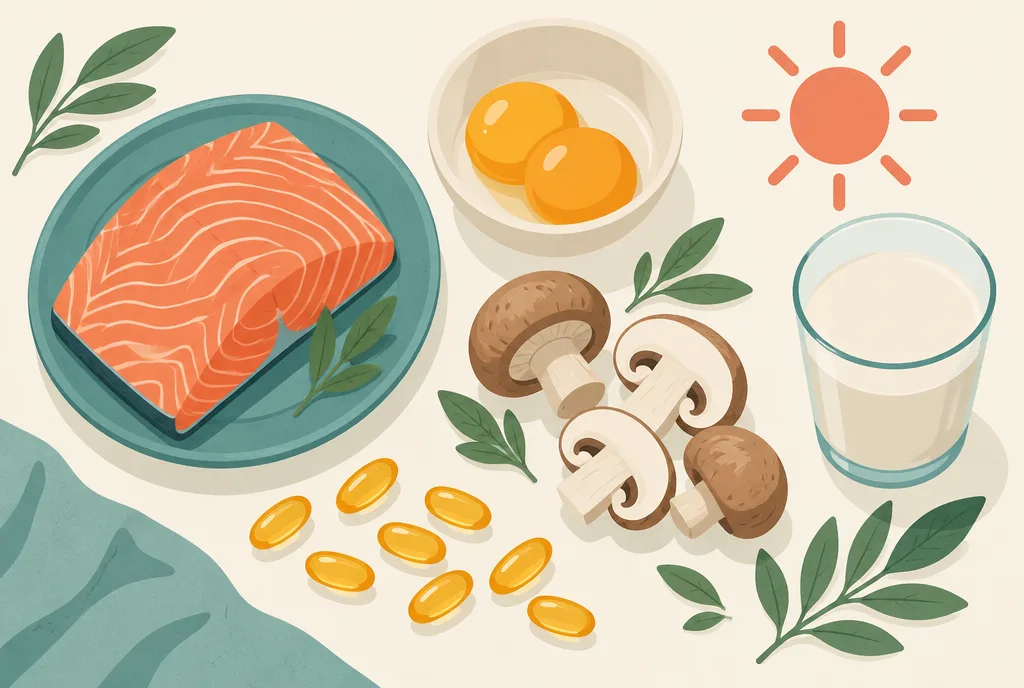
- Vitamin D3 (cholecalciferol): animal-derived — fatty fish, egg yolks, liver — and the form your skin naturally produces. Most supplements source it from lanolin (sheep's wool); vegan versions come from lichen.
- Vitamin D2 (ergocalciferol): plant/fungal-derived, found in UV-exposed mushrooms and used to fortify cereals and plant milks. Historically the only prescription-strength vitamin D.
Both raise blood levels. How efficiently — and for how long — is where the evidence diverges.
D3 is substantially more effective
A 2023 meta-analysis of 31 RCTs in Advances in Nutrition — the most comprehensive comparison to date — found D3 raised total 25-hydroxyvitamin D roughly 40% more than D2 at equivalent doses. An earlier 2012 meta-analysis in the American Journal of Clinical Nutrition put the advantage even higher: 1.7 to 3 times more potent. That is not a rounding error — it's the difference between correcting a deficiency and spending months barely moving the needle.
The biochemistry explains why. The liver enzyme CYP2R1 has greater natural affinity for D3, and vitamin D binding protein carries it more tightly, so more D3 reaches circulation and stays there. D2 degrades faster — peak blood concentrations after an equivalent D2 dose run about 30% lower, per pharmacokinetic modeling in PLOS ONE. D3 is also stored in fat and muscle and released slowly, so it sustains higher levels between doses; missing a day matters less, while D2 really needs daily dosing.
For diagnosed deficiency (below 20 ng/mL) the gap widens further: a 2022 systematic review in Nutrients found D3 corrects deficiency faster and holds higher sustained levels at the same dose. Some research even suggests supplemental D2 may compete with, and reduce, your circulating D3. That needs confirmation, but it's one more reason to make D3 your default.
Head-to-head
| Factor | Vitamin D3 | Vitamin D2 |
|---|---|---|
| Source | Animal-derived (or lichen for vegan) | Plant/fungal-derived |
| Blood level increase | 40–300% higher at equivalent dose | Lower per dose |
| Peak concentration | Higher | ~30% lower |
| Fat tissue storage | Yes — slow release over months | Minimal |
| Deficiency correction | Faster | Slower |
| Prescription form | Limited (mostly OTC) | Yes (50,000 IU weekly) |
| Vegan-friendly | Lichen/microalgae forms available | Yes |
---
When D2 is still the right choice
- Vegans — with a caveat. D2 was historically the only plant-derived option, but lichen-sourced D3 has been widely available since around 2010 and is biochemically identical to animal-derived D3. Seek out vegan lichen D3 rather than defaulting to D2.
- Insurance-covered prescriptions. High-dose D2 (50,000 IU weekly) is a decades-old standard, often covered when over-the-counter D3 is not. If cost is the barrier, it's legitimate — take it more frequently and have levels monitored.
- Certain kidney disease scenarios. Some nephrologists prefer D2 in chronic kidney disease for phosphate-metabolism and enzyme-pathway reasons — a call for your physician.
- Fortified foods. The D2 in cereals and plant milks is low-dose enough that the bioavailability gap is a minor concern.
How much do you need?
The NIH Office of Dietary Supplements RDA is 600 IU daily for ages 1–70 and 800 IU past 70, with a safe upper limit of 4,000 IU per day. Many researchers argue that's too low for people at northern latitudes, with darker skin, or mostly indoors. Practical adult ranges: 1,000–2,000 IU D3 daily for maintenance, 2,000–4,000 IU for mild-to-moderate deficiency, and up to 10,000 IU per day only under physician supervision.
One habit improves either form: take it with a fat-containing meal — olive oil, avocado, nuts, fish. A randomized controlled trial found absorption can rise by up to 50% versus an empty stomach.
---
Quick answers
My doctor prescribed D2 — should I switch?
Talk to your doctor before changing anything; prescription D2 is a well-established protocol. On a maintenance dose, ask whether standard or vegan D3 is appropriate instead.
How long until a blood test shows a change?
Expect 8–12 weeks, with levels plateauing around 3 months on a stable dose. Test before and after to confirm your dose is working — optimal is generally 40–60 ng/mL.
The bottom line
D3 is the evidence-supported default; D2 earns its place mainly for covered prescriptions and select clinical cases. Whichever you take, pair it with a fatty meal and confirm with a blood test. Higher doses — and any supplementation with kidney disease, hypercalcemia, or interacting medications — belong under a doctor's guidance. Not sure vitamin D is even your gap? Our free quiz shows what is worth testing first.