

Recovery is where results are actually made
You trained hard, and 48 hours later walking down stairs feels like a negotiation. That ache — delayed-onset muscle soreness (DOMS) — is a signal that your muscle fibers took microscopic damage and your body is busy repairing them. Here is the truth most marketing hides: you do not get stronger during the workout, you get stronger during the repair that follows. If that repair is slow or under-fueled, you train less often, lift less, and stall.
A small handful of supplements have genuinely strong evidence behind them, and most products screaming RAPID RECOVERY on the label do not. This guide separates the two, with an honest evidence grade, the studied dose, and what to buy. One principle underlies everything: food first, supplements second. No capsule out-recovers adequate protein, enough calories, and enough sleep.
Take the free supplement quiz →
---
The all-stars: Strong evidence
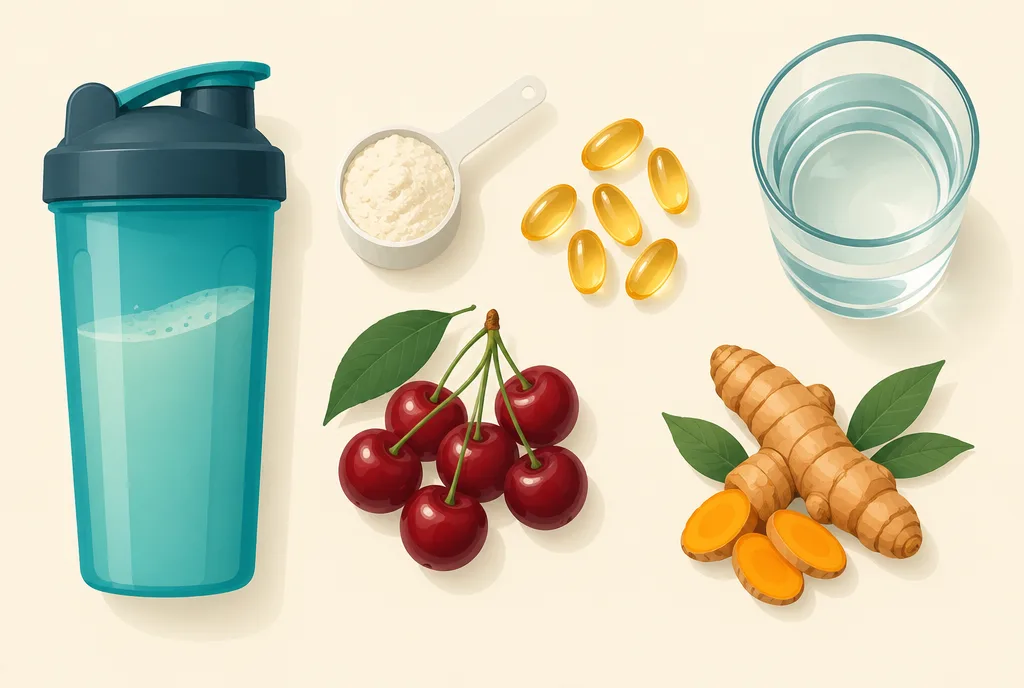
Protein is the non-negotiable foundation — muscle repair is literally rebuilding protein. The ISSN position stand recommends roughly 0.25 g of high-quality protein per kg per meal, or 20–40 g per dose, each dose ideally carrying 700–3,000 mg of leucine — the amino acid that flips the muscle-protein-synthesis switch. After whole-body training, 40 g of whey stimulated synthesis about 20% more than 20 g, so big sessions may justify the larger dose (Macnaughton et al., 2016). Whey post-workout, casein before bed, blended plant proteins if you combine sources. Aim for ~1.6–2.2 g/kg bodyweight daily. Buy a whey isolate or blend delivering 25–40 g protein per serving.
Creatine monohydrate is the most-studied supplement in sports nutrition. The ISSN position stand on creatine — drawing on 1,000+ studies — calls it the most effective ergogenic aid available, with a strong safety record; it also appears to reduce muscle-damage markers and speed recovery between efforts. A 2026 network meta-analysis found creatine and protein were the standout interventions for strength and recovery in trained athletes (Nutrients, 2026). Dose: 3–5 g every day — timing is nearly irrelevant. Skip HCL, buffered, and liquid versions; plain monohydrate powder is cheaper and better studied.
The soreness-reducers: Moderate evidence
These will not build muscle, but they can meaningfully blunt DOMS during hard blocks and competitions.
- Omega-3 (EPA/DHA): a meta-analysis of RCTs found omega-3 significantly reduced soreness after eccentric exercise, though not strength recovery (systematic review). Take 2–3 g combined EPA+DHA daily with food — the effect builds over weeks. Choose a concentrated fish oil that lists EPA and DHA amounts.
- Tart cherry: its anthocyanins reduce soreness and strength loss in most studies reviewed (systematic review), and it may work best loaded for a few days before a hard event — precovery, not just recovery (review). ~480 mg extract or 30 mL concentrate twice daily for 4–5 days around the bout.
- Curcumin: reduced soreness and creatine kinase, a blood marker of muscle damage, in a meta-analysis of RCTs (Fang et al., 2020). Plain curcumin absorbs poorly — use a piperine or phospholipid form, 500 mg twice daily with a fatty meal on hard-training days.
Situational: Limited evidence
Vitamin D and magnesium help mainly if you are actually low — test, then correct (1,000–2,000 IU D3 daily; 200–400 mg magnesium glycinate in the evening for sleep and cramps). BCAAs are heavily marketed, but if you already hit your daily protein target they add little; they matter mainly for fasted training.
---
At a glance
| Supplement | Evidence | Typical dose | When to take |
|---|---|---|---|
| Protein (whey/blend) | Strong | 25–40 g (0.25 g/kg) | Around training; spread across day |
| Creatine monohydrate | Strong | 3–5 g | Any time, every day |
| Omega-3 (EPA/DHA) | Moderate | 2–3 g EPA+DHA | Daily, with food |
| Tart cherry | Moderate | ~480 mg extract 2x | 4–5 days around hard events |
| Curcumin | Moderate | 500 mg 2x, enhanced form | With fatty meal, hard days |
| Vitamin D | Limited (Strong if deficient) | 1,000–2,000 IU | Daily, with food |
| Magnesium glycinate | Limited | 200–400 mg | Evening |
| BCAAs / EAAs | Limited | 5–10 g | Fasted sessions only |
---
One caveat: the antioxidant trade-off
High-dose antioxidants — including the polyphenols in tart cherry and curcumin — can blunt some of the adaptive signaling that inflammation triggers. In an off-season building block, keep that signal and lean on protein, creatine, sleep, and food. Save the aggressive anti-inflammatory tools for competition weeks and back-to-back events, when fast recovery matters more than adaptation.
The bottom line
Protein and creatine are the two supplements with Strong evidence for recovery, and they belong at the base of every stack. Hit ~1.6–2.2 g/kg protein daily, take 3–5 g creatine monohydrate, sleep 7–9 hours, and eat enough. From there, omega-3, tart cherry, and curcumin are legitimate soreness tools for hard blocks and events; vitamin D, magnesium, and BCAAs are worth it mainly to correct a specific gap. Everything else in the rapid-recovery aisle is, at best, Limited — spend your money where the research actually points.