

When iron is supposed to help — but it wrecks your gut
You got the low-ferritin result, your doctor told you to take iron, and within three days you are constipated, nauseated, and staring at a bottle you can barely stomach. Conventional iron pills cause real, dose-related gut misery for a large share of people — and the standard advice to just push through is both miserable and, it turns out, scientifically unnecessary.
The good news: the tolerability problem is mostly a form problem and a dosing problem, not an iron problem. Change the type of iron you buy and how often you take it, and most people go from dreading their supplement to barely noticing it — while absorbing more iron, not less.
Take the free supplement quiz →
---
Why standard iron upsets your stomach
The classic prescription — ferrous sulfate — is cheap and effective, but a 2015 systematic review and meta-analysis found it roughly doubles the risk of GI side effects versus placebo (odds ratio ~2.32), led by nausea, constipation, cramping, and metallic taste. The culprit is unabsorbed iron: only a fraction of each dose is taken up, and the leftover iron sits in your gut generating irritation.
Two facts follow from this, and both point to the fix: give iron in a more absorbable form, and give less of it, less often.
---
The single best change: ferrous bisglycinate
Evidence: Strong
Ferrous bisglycinate is iron bound to two glycine amino acids — chelated — and that wrapper lets it absorb through a different, gentler pathway, so less free iron is dumped into your gut. A 2023 systematic review and meta-analysis of RCTs found it reliably raises hemoglobin and ferritin, and a randomized controlled trial in pregnant women found it corrected iron deficiency with better GI tolerability than conventional salts at a lower elemental dose. A broader 2024 comparison of oral iron salts reached the same practical conclusion: chelated iron matches sulfate on efficacy while causing fewer complaints.
If you have IBS, gastritis, or you already failed ferrous sulfate, skip straight to bisglycinate — it is the highest-value change here. Dose: 25 mg of elemental iron — plenty for most maintenance and mild-to-moderate deficiency; you do not need the 65 mg found in sulfate tablets. What to buy: a chelated gentle iron delivering ~25 mg elemental iron per capsule. View ferrous bisglycinate on Amazon
The second-best change: take it every other day
Evidence: Strong
This is the part most people have never heard. Landmark absorption studies by Stoffel and colleagues in Haematologica (2019) showed that a single iron dose spikes hepcidin — the hormone that blocks iron absorption — for about 24 hours. A second dose taken the same day, or even the next morning, is largely wasted: it barely absorbs but still irritates your gut. Take iron every other day and hepcidin falls back to baseline, so the next dose absorbs more efficiently. A 2023 randomized trial confirmed alternate-day dosing matches daily dosing for raising iron stores with fewer side effects. You take fewer pills, feel better, and lose nothing.
Vitamin C: helpful, not mandatory
Evidence: Moderate
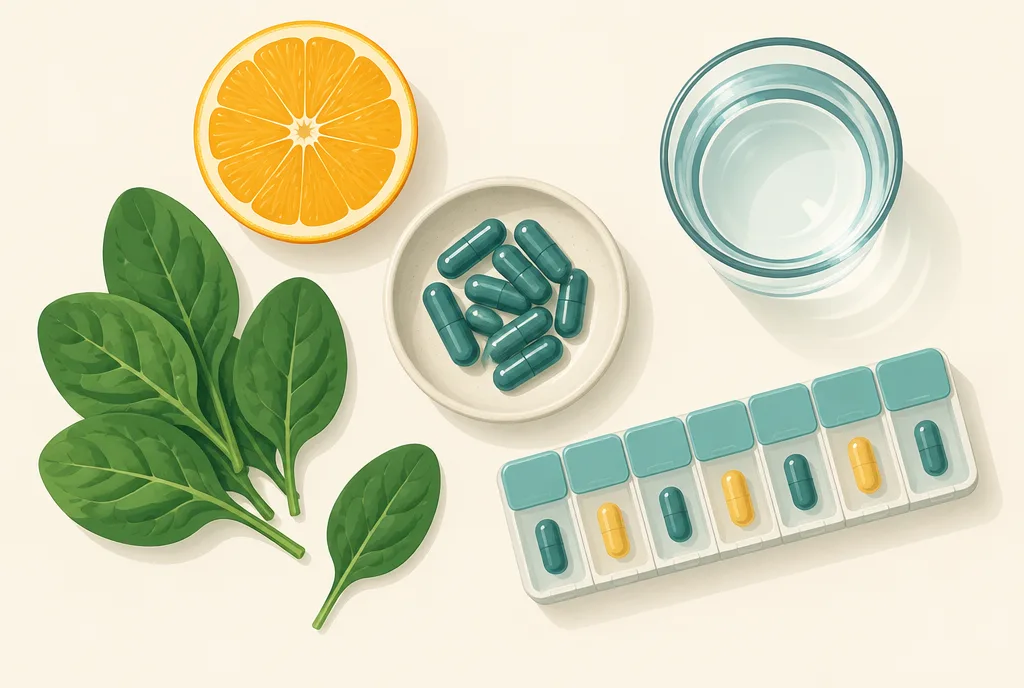
Vitamin C boosts non-heme iron absorption in the lab, and pairing your dose with a little — an orange, a 100–250 mg tablet, or food — is a reasonable, cheap habit. But newer clinical data show that for correcting deficiency, routine high-dose vitamin C is not essential — proper form and timing matter far more.
What to avoid alongside your dose
Take iron away from these, which sharply cut absorption:
- Coffee, tea, and red wine (polyphenols)
- Dairy and calcium supplements
- Antacids and proton-pump inhibitors
- High-fiber meals eaten at the same time
Iron forms at a glance
| Form | Elemental iron | GI tolerability | Best for |
|---|---|---|---|
| Ferrous bisglycinate (chelated) | ~25 mg | Best | Sensitive stomachs, IBS, prior failures |
| Ferrous sulfate | ~65 mg | Poor | Cheapest; if you tolerate it |
| Ferrous gluconate | ~35 mg | Moderate | Middle ground |
| Ferrous fumarate | ~33 mg | Moderate–poor | Higher elemental dose |
| Iron polymaltose / heme iron | varies | Good | Alternative gentle options |
---
Your gentle-iron protocol
- Buy ferrous bisglycinate, ~25 mg elemental iron.
- Take it every other day, not daily — same results, fewer side effects.
- Take it in the morning, ideally 30–60 minutes before food, or with a small snack.
- Pair with vitamin C if convenient; do not obsess over it.
- Separate from coffee, tea, dairy, and antacids by at least 1–2 hours.
- Recheck ferritin and hemoglobin in 8–12 weeks. Iron stores rebuild slowly.
Bottom line
Iron does not have to hurt. Most GI misery comes from a poorly absorbed form given too often. Switch to ferrous bisglycinate at ~25 mg elemental iron, taken every other day, keep it away from coffee and dairy, and add a little vitamin C if it is easy. If you have genuinely failed multiple oral forms — or your deficiency is severe — talk to your doctor about IV iron.
This article is educational, not medical advice. Iron supplementation should be guided by blood work — ferritin, hemoglobin, transferrin saturation — because too much iron is harmful and some people carry genetic conditions like hemochromatosis. Always consult a qualified healthcare provider before starting or changing any supplement, especially if you are pregnant, have a chronic condition, or take medications.