
You bought turmeric — but did you buy anything that works?
Any pharmacy has a wall of golden bottles — some labeled turmeric, some curcumin, some both — priced from $8 to $45 for what looks like the same thing. It is not. The label difference between turmeric and curcumin, and whether the product has an absorption enhancer, is the single biggest predictor of whether you will feel anything at all.
The uncomfortable truth: a 1,000 mg capsule of plain turmeric root powder may deliver as little as 20–30 mg of active compound, mostly destroyed before reaching your bloodstream. The research showing turmeric rivals ibuprofen for knee arthritis used concentrated, standardized, absorption-enhanced extracts.
Take the free supplement quiz →
---
Turmeric vs curcumin: the difference that changes everything
Turmeric is the whole root — the bright orange-yellow spice. Curcuminoids are the bioactive polyphenols inside it, and curcumin is the most-studied one, responsible for most of the anti-inflammatory effects.
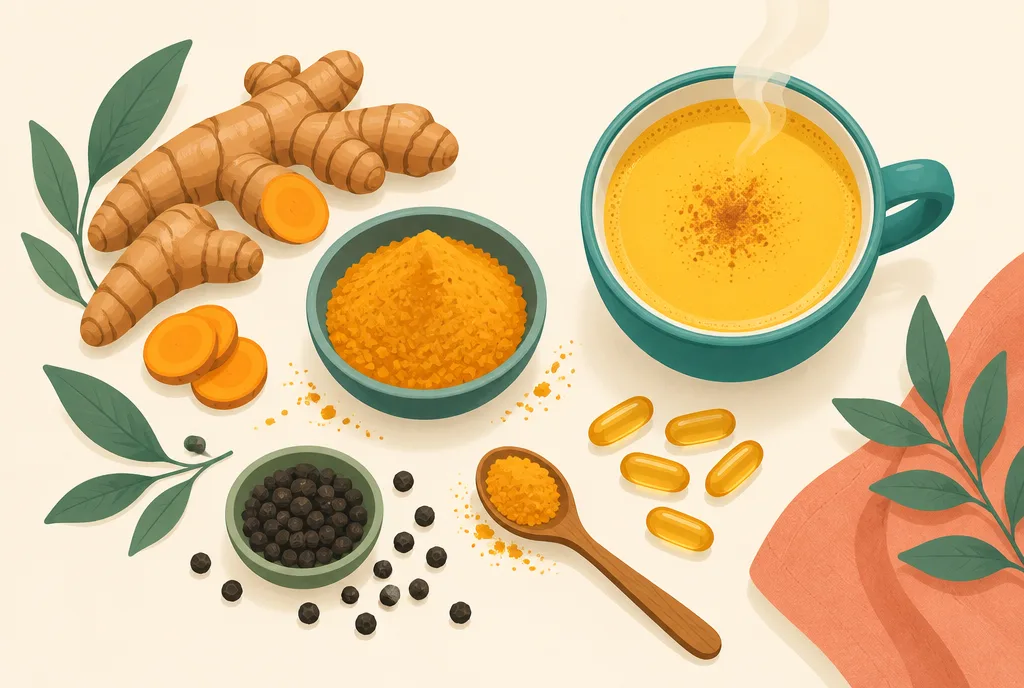
The problem is concentration. Raw turmeric root is only about 2–5% curcuminoids by weight, and independent testing found curcuminoid content varies enormously batch to batch (PMC 2024). A standardized 95%-curcuminoid extract delivers ~950 mg per 1,000 mg capsule versus ~20–80 mg from root powder; matching trial doses with plain spice would take 5–10 g a day — enough to cause nausea.
Bottom line: plain turmeric is fine and cheap for cooking and everyday wellness. For a measurable effect on joint pain or inflammation, you want the standardized extract with an absorption enhancer.
The bioavailability problem
Even pure curcumin is barely absorbed — poorly water-soluble, rapidly metabolized in the gut and liver, and eliminated fast — so formulation matters more than dose. In the landmark trial by Shoba et al., 1998, just 20 mg of piperine (black pepper extract) taken with 2 g of curcumin raised human bioavailability roughly 2,000% — a 20-fold jump — which is why so many products bundle in black pepper.
Newer delivery systems repackage curcumin physically:
- Phytosome or phospholipid (Meriva, Longvida): roughly 20–30x better absorbed
- Micellar (NovaSOL): among the highest-absorption forms in head-to-head studies
- Submicron (Theracurmin): ~20x higher peak blood levels than plain curcumin
- Turmeric-oil matrix (BCM-95): uses the root's own essential oils
A lower dose of a well-formulated product can outperform a higher dose of cheap curcumin.
---
What the evidence actually supports
Osteoarthritis and joint pain — strong. Multiple meta-analyses find curcumin extract non-inferior to NSAIDs like ibuprofen and diclofenac for knee osteoarthritis pain, with significantly fewer gastrointestinal side effects (2022 meta-analysis). Caveat: many trials are small and industry-funded, so the effect may be overstated.
Moderate evidence. Curcumin reliably lowers the inflammation marker CRP — strongest at ≤1,000 mg/day for over 10 weeks (Phytotherapy Research). Meta-analyses also find a significant antidepressant effect versus placebo (2017 meta-analysis) — trials are short, so treat it as an adjunct, not a replacement. In type 2 diabetes it modestly improves fasting glucose, HbA1c, triglycerides, and LDL, and it reduces post-exercise muscle soreness.
Weak or no evidence. Human cognition trials are a letdown — an updated meta-analysis found no significant effect on global cognition — and cancer outcomes in humans have been unconvincing. Ignore both marketing claims.
| Use case | Evidence grade | Practical verdict |
|---|---|---|
| Osteoarthritis / joint pain | Strong | Best reason to buy; rivals NSAIDs |
| Inflammation (CRP) | Moderate | Real, dose ≤1,000 mg/day, 10+ weeks |
| Depression / mood | Moderate | Possible adjunct, short trials |
| Blood sugar / lipids | Moderate | Small, supportive effect |
| Exercise recovery | Moderate | Modest; use enhanced form |
| Cognition / Alzheimer's | Limited | Do not count on it |
| Cancer | Insufficient | Ignore the marketing |
---
How to dose it (and what to actually buy)
- Therapeutic dose: 500–2,000 mg/day of a 95%-curcuminoid extract, split in two; ~1,000–1,500 mg/day is the sweet spot
- Take with food containing fat — curcumin is fat-soluble — and/or with an absorption enhancer
- Be patient: allow 8–12 weeks
- More is not better: above ~2,000 mg/day you get diminishing returns and more stomach upset
On the label: the word curcumin or curcuminoids (not just turmeric), standardized to 95% curcuminoids, and a named absorption system. View standardized curcumin with BioPerine on Amazon or, for a piperine-free high-absorption option, view Meriva / Theracurmin formulas on Amazon.
---
Safety: the liver news you need before you buy
Curcumin is generally well tolerated — mild GI upset hits about 5% of users. But the U.S. Drug-Induced Liver Injury Network has documented turmeric-associated liver injury — 10 cases in one series, including one fatal acute liver failure (DILIN case series) — and the NIH LiverTox monograph now lists turmeric as a recognized cause, typically surfacing one to four months in. The risk appears higher with piperine-enhanced and highly bioavailable formulations (PMC 2025). Rare but real: stop and see a doctor if you develop fatigue, dark urine, or yellowing skin.
Avoid or use caution with gallbladder disease or gallstones (turmeric stimulates bile flow), blood thinners or antiplatelet drugs, upcoming surgery (stop ~2 weeks before), iron deficiency (high doses impair non-heme iron absorption), and diabetes medication (additive glucose lowering). On any prescription? Clear it with your clinician or pharmacist first.
The bottom line
Turmeric is not curcumin. Buy a 95%-curcuminoid extract with an absorption system, take 1,000–1,500 mg/day with a fat-containing meal, give it 8–12 weeks, and skip it for brain and cancer claims. Not sure joint support is your biggest gap? Our free quiz shows what your diet actually leaves on the table.