
Hair loss in women is usually a nutrient problem
Noticing more strands in the shower drain, a wider part, or a thinning ponytail? The temptation is to grab whatever bottle promises hair, skin, and nails. Most are biotin gummies in a pink jar — and biotin is almost never why your hair is shedding.
The evidence-based picture is narrower and more useful: in women, the most common reversible drivers of hair loss are low iron (ferritin), low vitamin D, low zinc, suboptimal protein, and chronic stress. Here is every popular option ranked by evidence quality, plus a practical 90-day protocol.
Take the free supplement quiz →
---
The evidence-graded ranking
Iron — strong evidence (in deficiency). The most under-recognized cause of shedding in women. The marker that matters is serum ferritin, not hemoglobin — stores can be depleted while hemoglobin is normal — and menstruating women, vegetarians, blood donors, and endurance athletes are most at risk. A 2013 review in the International Journal of Trichology and a comprehensive 2019 review in Dermatology and Therapy agree: iron helps if you are deficient; most experts target ferritin above 40–70 ng/mL. Test first — iron overload is real and damaging. If low, iron bisglycinate at 25–50 mg every other day absorbs better than daily dosing (hepcidin rebound).
Vitamin D — strong evidence (in deficiency). Hair follicles have vitamin D receptors, and a 2020 meta-analysis found significantly lower levels in non-scarring alopecia. Deficiency is common and supplementation cheap and safe. Aim for 25(OH)D of 40–60 ng/mL — most women need 2,000–4,000 IU of D3 paired with K2 daily with a fatty meal.
Zinc — strong evidence (in deficiency). Zinc is required for keratin synthesis and follicle cycling, and a 2013 case-control study found lower serum zinc across all four major hair-loss types. Take 15–30 mg of zinc picolinate with food; stay under 40 mg/day — high zinc depletes copper.
Marine protein complexes — moderate evidence. Viviscal-type AminoMar blends are the rare hair product tested in double-blind RCTs: a 2015 placebo-controlled trial showed more terminal hairs and less shedding over 90–180 days, replicated in 2018. Industry-funded but consistent. A reasonable add-on once bloodwork is optimized; judge at 3–6 months.
Saw palmetto — moderate evidence. It inhibits 5-alpha-reductase, blocking DHT — the androgen behind pattern loss. A 2020 systematic review found modest but real density improvements — smaller than finasteride, friendlier side-effect profile. For female pattern loss: 320 mg of standardized extract daily. Avoid if pregnant, trying to conceive, or on hormonal therapy without doctor sign-off.
Pumpkin seed oil and collagen — limited evidence. In one 24-week trial, 400 mg/day of pumpkin seed oil raised mean hair count 40% in men; a small 2021 trial in women suggested density benefits. Cheap and safe, but thin data. Collagen is mostly a protein top-up — helpful if you eat under ~0.8 g/kg/day of protein, redundant otherwise.
Biotin — insufficient evidence. Deficiency is rare, and outside true deficiency a 2017 review found no evidence it improves hair growth. Worse, high-dose biotin interferes with critical lab tests — troponin, TSH, hormone panels — per FDA safety communications. Skip 5,000–10,000 mcg gummies; a multivitamin's 30–100 mcg is plenty.
Caution: selenium and vitamin A. Excess harms — selenium toxicity directly causes hair loss (stay under 200 mcg/day), and excess vitamin A is a classic cause of telogen effluvium.
---
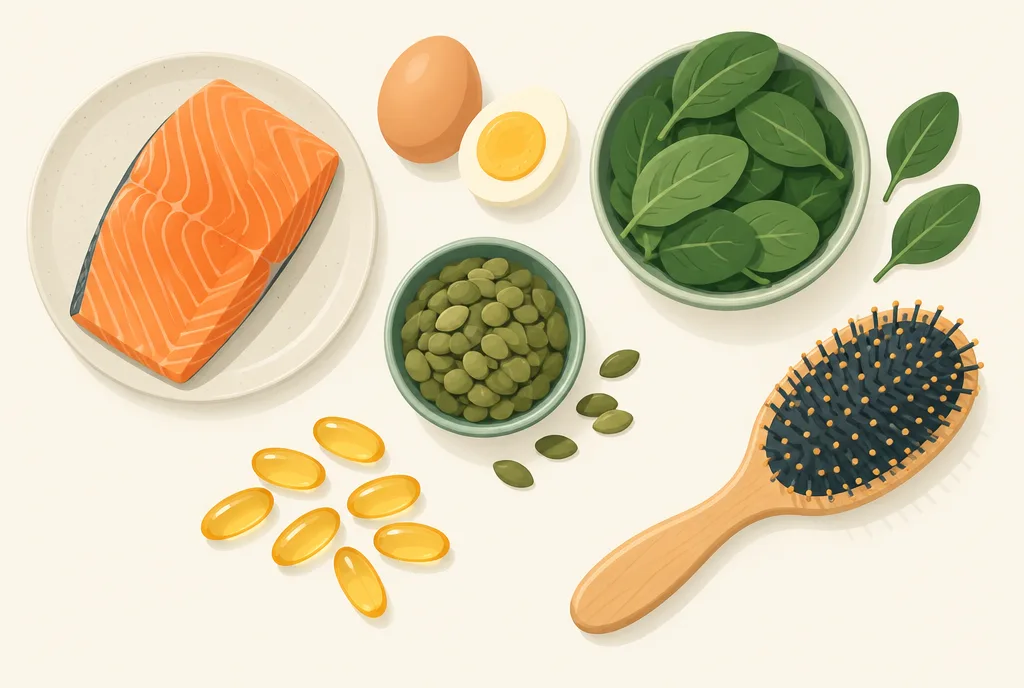
Which kind of hair loss do you have?
Supplements only work for certain mechanisms — pick the wrong target and you waste six months. Shedding that began 2–4 months after a trigger (postpartum, illness, crash diet, major stress) is almost certainly telogen effluvium, the form most likely to respond.
| Pattern | What it looks like | Responds to supplements? |
|---|---|---|
| Telogen effluvium | Diffuse shedding 2–4 months after a trigger | Yes — often dramatically |
| Female pattern hair loss | Widening part, thinning crown | Partially — saw palmetto |
| Alopecia areata | Round, smooth bald patches | Not a standalone fix |
| Traction alopecia | Hairline loss from tight styles | No — change your styling |
| Scarring alopecias | Smooth, shiny scalp, no follicles | No — see a dermatologist |
---
The practical 90-day protocol
Step 1 — bloodwork before you buy anything: ferritin (target above 40–70 ng/mL), 25-hydroxy vitamin D (40–60 ng/mL), TSH and free T4, and a CBC.
Step 2 — protein and calories. Hair is a luxury tissue — your body sheds it first when it thinks you are starving; crash diets often precede shedding. Aim for at least 1.0–1.2 g protein per kg daily.
Step 3 — supplement to your labs: low ferritin → iron bisglycinate 25 mg every other day with vitamin C; low vitamin D → 2,000–4,000 IU D3 with K2; low zinc → 15–30 mg picolinate; low protein → 10–20 g collagen or whey.
Step 4 — optional add-ons: marine protein complex, saw palmetto 320 mg for pattern loss, pumpkin seed oil 400 mg.
Step 5 — patience. New growth takes 3 months minimum; visible thickening takes about 6.
When to see a dermatologist
Skip the self-experiment if you have smooth bald patches, scalp pain or scaling, sudden rapid loss, shedding with fatigue or menstrual changes (think thyroid or PCOS), or over 12 months of progressive thinning. Some hair loss is medical, not nutritional — and untreated scarring alopecias become less reversible over time.
Bottom line
For most women with diffuse shedding, the highest-yield moves are iron and vitamin D correction, adequate protein, and time. Marine protein and saw palmetto are the legitimate second tier, pumpkin seed oil a reasonable adjunct, biotin mostly marketing. Treat hair loss like the systemic signal it is, give the follicle cycle 3–6 months, and stop buying gummies.